
What actually happens in a Personal Safety Program workshop
Four modules, a content warning, a lot of standing up, and a reflection after every one. A plain walk-through of the half day for anyone weighing up a team day.
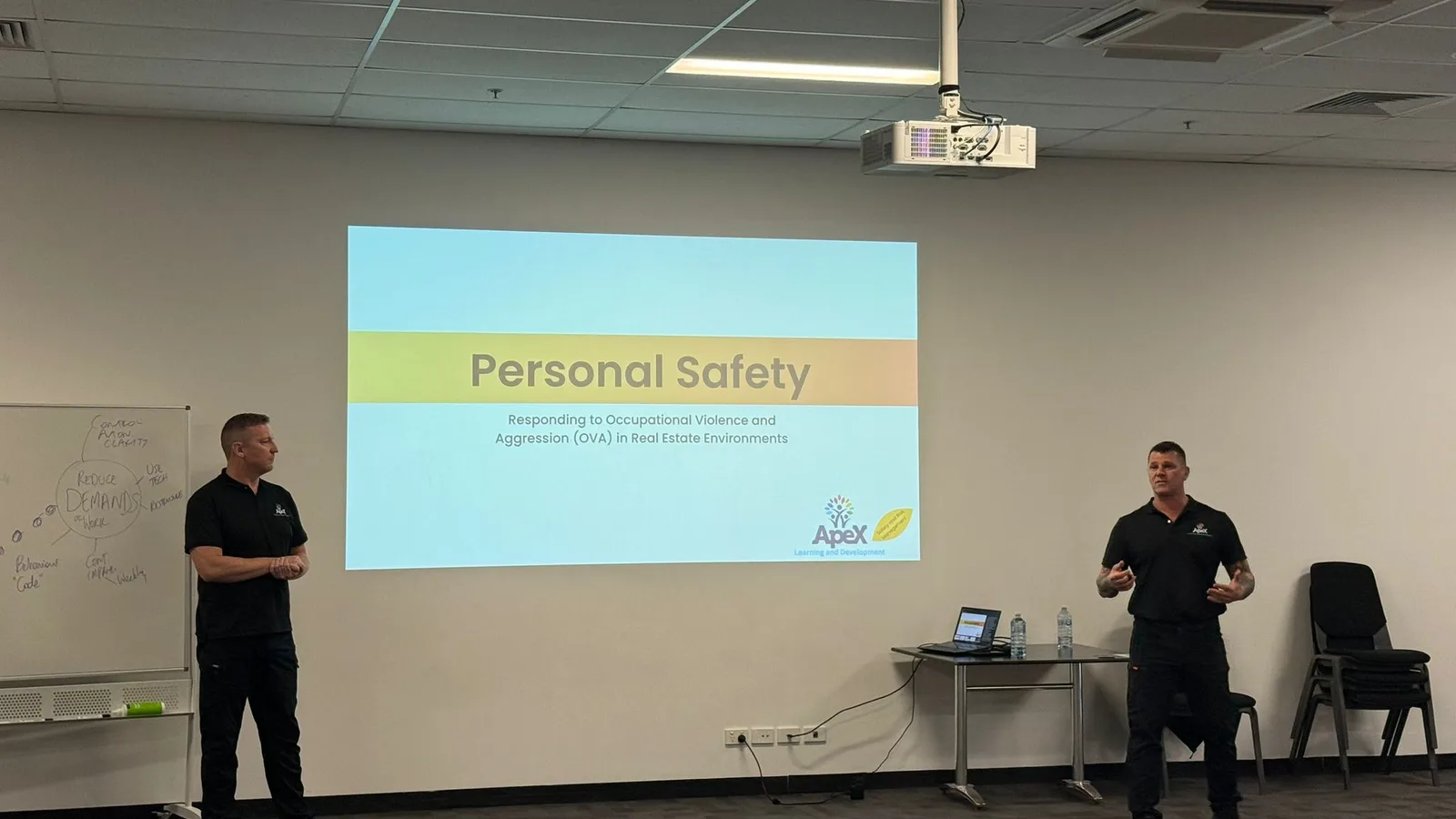
People ask two questions before they bring a team to this program. Is it going to be a lecture? And is somebody going to get thrown on a mat?
No, and no. Here is what actually happens.
It starts with a warning, on purpose
The first slide is a content warning. The program discusses real situations and teaches physical self-defence techniques, and anyone with a physical or psychological concern is asked to speak to the facilitator before it starts. That is not a formality. Some people in the room have already been on the wrong end of an aggressive client, and the workshop is built so that they are in control of how far they go.
Then the room gets on its feet, and mostly stays there.
Module one: the room you work in
Environmental safety. Identifying and controlling personal safety hazards in the places your people actually work. For a property manager that is open for inspections, private inspections, vacant properties, the office, the vehicle and online. For a community services team it is the home visit and the car park. For a school it is the front office and the gate.
The team runs the risk management process across their own settings: identify the hazard, analyse the risk, control it, monitor and review. Exits. Lines of sight. What you can change about a space before anyone difficult walks into it.
Module two: the risks you can control
Personal safety. Trusting your intuition and recognising unsafe behaviours. The pre-appointment plan: where you will be, who you are meeting, how long it should take, told to someone who will notice if the answers stop being true. Safe positioning. How presentation, tone and choice of words shape the first thirty seconds. How to exit a situation that is turning.
This is the module teams keep using. Months later, the three questions are still being asked.
Module three: before it peaks
Responding to escalation. The verbal cues that a situation is turning: direct threats, personal insults, demands, an argumentative tone, rapid speech, sarcasm. The non-verbal ones. The difference between defusing, which is preventive, and de-escalating, which is active. Validating the feeling without validating the behaviour. Space. Plain language. Offering choices. Staying calm as a practised skill rather than a personality trait.
Everything in this module is done in pairs, out loud, with a colleague playing the other side.
Module four: when it is already out of control
Responding to emergencies. Fight, flight or freeze, and why most untrained people freeze. Creating distance. Evacuating other people. Calling for help. Then, and only then, self-defence fundamentals: stances, blocks and escapes, practised in pairs, for the situation where escape is not possible. Physical force is always the last step, always reasonable and proportionate, consistent with the law.
The module closes on self-care and recovery, because staying safe at work is about more than the moment of an incident.
After every module: what, so what, now what
Each module ends with the same three-part reflection. What happened in that module. So what does it mean for your work. Now what will you do differently. Nobody leaves without knowing what to take back to the job, and because the whole team did it together, they take back the same things.
The practical details
Delivery is on site, practitioner-led, and scoped to your team: half a day as standard, longer where your setting needs it. Every module includes practical work. Participants receive an Apex Certificate of Attendance.
The Personal Safety Program is a non-accredited professional development program delivered by Apex Learning and Development, RTO 46324. It was developed with the expertise of Martial Fitness Australia and Crosse Training.
If you are weighing it up as a team day, tell us your team size and your setting and we will build it around you.
The Personal Safety Program is a non-accredited professional development program. It is not nationally recognised training and does not lead to a qualification or statement of attainment. Physical techniques are taught as a last resort only, using reasonable and proportionate force consistent with the law.