
Where, who, how long: the three-question habit that keeps a team connected
Lone workers are only alone if nobody knows where they are. The pre-appointment plan is the simplest team habit in the Personal Safety Program, and the most used.
A lone worker is not someone who works by themselves. It is someone who, at the moment it goes wrong, has nobody who knows where they are.
Property managers at a routine inspection. Support workers on a home visit. Sales reps in a client's office. Nurses on a community round. Real estate agents at an open home with a stranger's car in the driveway. Every one of them is part of a team. Most of the time, the team has no idea which door they just walked through.
The plan is for the person who is not in the room
Module two of the Personal Safety Program is about controlling the risks you can control, and the first habit it builds is the pre-appointment communication plan. Three questions, answered before you leave, to someone who will notice if the answers stop being true:
- Where will you be?
- Who are you meeting?
- How long should it take?
That is it. It fits on a sticky note. It takes less than a minute. And it turns a solo appointment into a team appointment, because now there is a person back at base with a time in their head and a reason to make a call when it passes.
It is the simplest thing we teach, and when we follow up with teams months later, it is the thing they are still doing.
What the plan does
It changes the arithmetic of a bad situation. Aggression tends to escalate when the person doing it believes there are no consequences and no witnesses. A worker who has just said "I have told the office I will be here until half past two" has quietly introduced both.
It also changes the arithmetic for the team. Because the aggression rarely comes from inside the team; clients and customers are the most common source of violence against Australian workers. What the team can do is make sure nobody meets it without backup, and backup starts with knowing where to send it.
Why it needs the whole team in the room
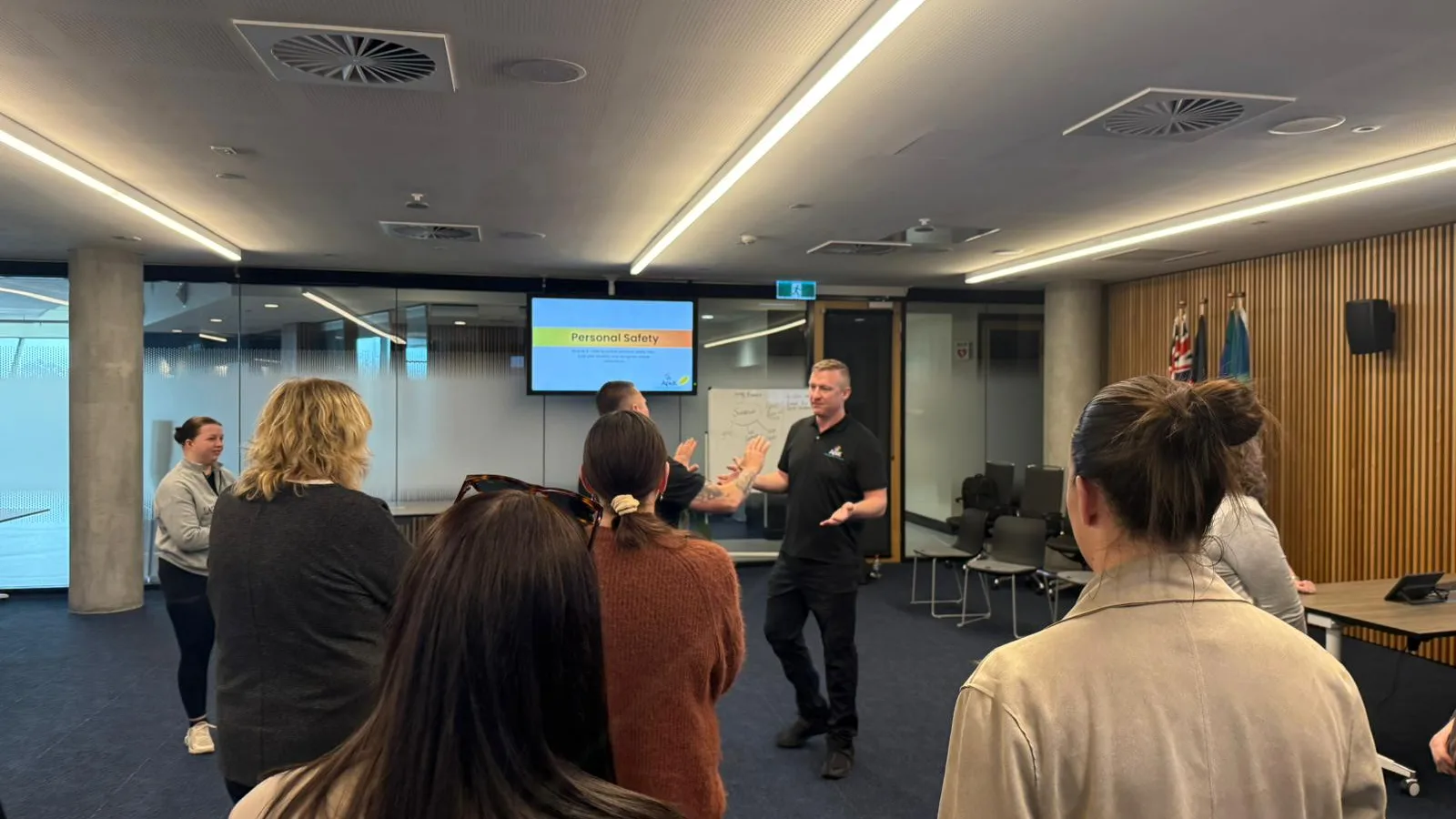
A plan only works if the person receiving it takes it seriously. That is why we run the Personal Safety Program with whole teams rather than sending individuals on a course. The office manager who will be on the other end of the call needs to practise the receiving side: what a check-in sounds like, what to do when the clock runs out, and how to escalate without overreacting.
When a team builds this together, it stops being one person's caution and becomes how the team works. Nobody has to feel awkward about asking a colleague to hold their appointment details, because everyone does it.
The rest of the module
The pre-appointment plan is the opening habit. The module goes on to cover trusting your intuition and recognising unsafe behaviours, safe positioning in a room or a doorway, how presentation and communication shape the first thirty seconds, and how to exit a situation that is turning. All of it is practised, not just described, and all of it is built around your team's actual settings.
The Personal Safety Program is a non-accredited professional development program delivered on site by Apex Learning and Development, RTO 46324. Participants receive an Apex Certificate of Attendance.
If your people work in other people's spaces, the three questions are a good place to start. Tell us about your team and we will build the rest around them.
Source for the statistic: Safe Work Australia, Workplace and work-related violence and aggression in Australia, 2024.
The Personal Safety Program is a non-accredited professional development program. It is not nationally recognised training and does not lead to a qualification or statement of attainment.