
Fight, flight or freeze: why we practise it together
Plenty of people freeze. The Personal Safety Program has teams practise the response together, under some pressure. What a team learns from a foam noodle.
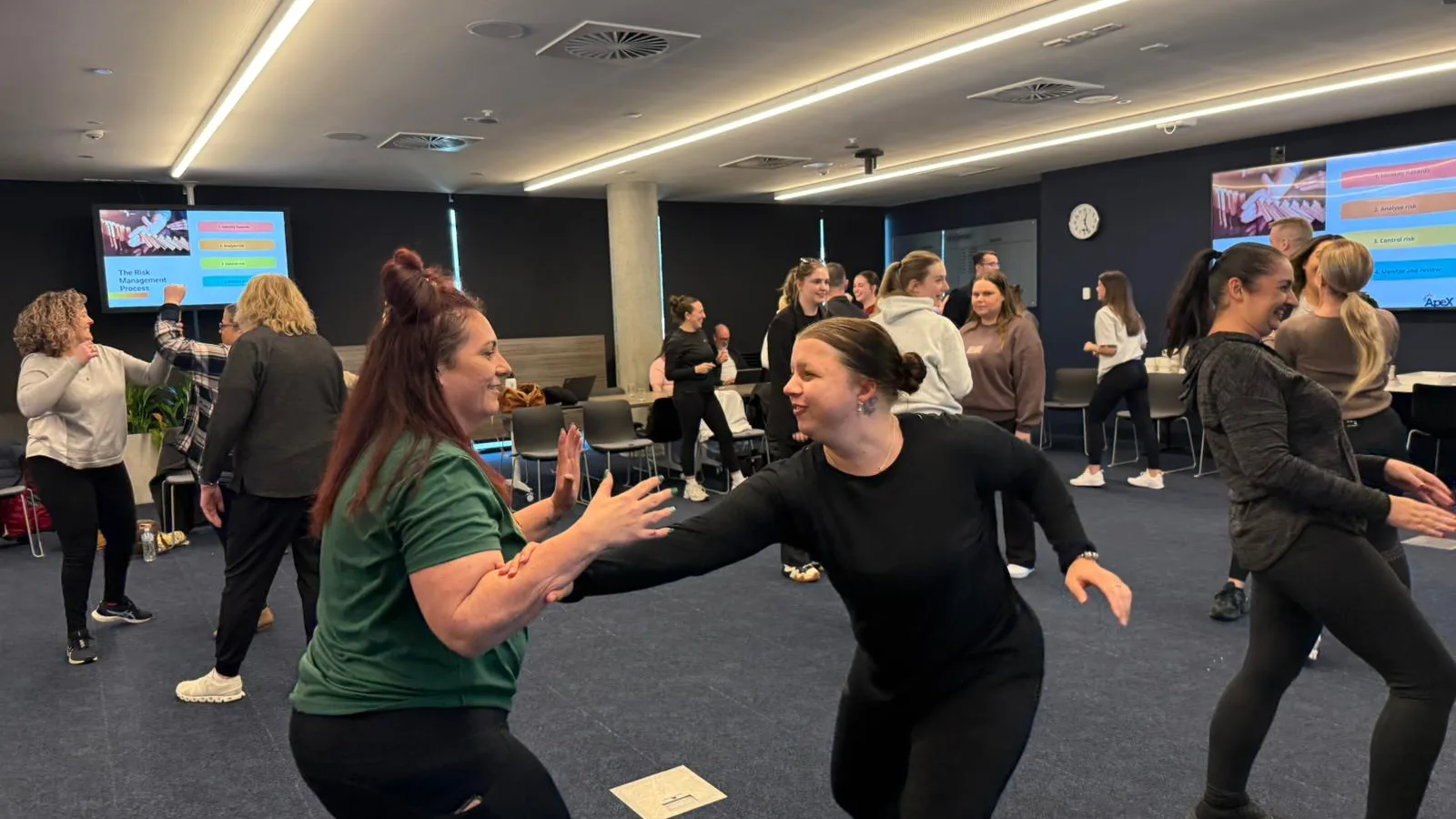
Ask a room of people what they would do if a client lunged at them, and many will describe something decisive. Step back. Call out. Get to the door.
Then hand a trainer a foam noodle and let them swing it, slowly and obviously, at a volunteer. Watch what actually happens.
Plenty of people freeze. Not because they are weak or unprepared in any way that reflects on them, but because that is what an untrained nervous system does when it meets a threat it has never rehearsed. Fight, flight or freeze is not a choice. It is physiology.
The good news about freezing
The response can be practised. Module four of the Personal Safety Program covers what fight, flight or freeze does to the body, and why preparation matters.
The body learns from repetition under something that feels like pressure. Not real danger, but enough adrenaline to make the hands slow and the thinking narrow. A foam noodle coming at your head does that surprisingly well. So does a colleague gripping your wrist and not letting go until you find the release.
So the program rehearses it, round after round: hands up, weight back, distance, exit. The skill is not sophisticated. The aim is that it has been done before, so the body has something to reach for. The physical skills are taught strictly as a last resort, when you cannot get away.
Why colleagues, not strangers
The program is designed for a whole team at a time, and the reason is not efficiency.
Practising something slightly uncomfortable in front of the people you work with does two things. It gives the team room to build trust, because nobody is expected to get it right in the first round, and everyone sees everyone else working it out. And it gives the team a shared response to practise, because the person beside you on the day is likely to be someone you work with.
The laughter in the room is not a distraction from the learning. People who are laughing are relaxed enough to try again.
The order of operations
Physical technique is always the last resort. Before any of it, the program teaches a duty of care hierarchy that the whole team learns in the same order:
- De-escalate. Words, tone, body language and space, before anything peaks.
- Evacuate other people. Colleagues, clients, bystanders. Get them clear.
- Remove yourself. Distance and a door beat any technique.
- Defend yourself, only if escape is not possible.
- Physical force, always last, only when you cannot get away, and within the law on self-defence.
Step two is the one that only works as a team. Someone has to know that when a colleague says it is time to clear the room, the room clears. That is worked out in training, not on the day.
Self-care is part of the program
Module four closes on self-care. Adrenaline does not switch off when the incident ends, and staying safe at work is about more than the moment.
The Personal Safety Program is a non-accredited professional development program delivered on site by Apex Learning and Development, RTO 46324. It is facilitated by Apex, built around your workplace, and every module includes practical activities. About half the session is hands-on: de-escalation role-play and physical drills in pairs. That practice is what the program is for. Participants receive an Apex Certificate of Attendance.
Call or email us now: Allan on 0433 895 537 or info@apexld.edu.au
Bring the room to your team. We will bring the noodles.
The Personal Safety Program is a non-accredited professional development program. It is not nationally recognised training and does not lead to a qualification or statement of attainment. Physical skills are taught only as a last resort, within the law on self-defence: force that is a reasonable response to the threat as you perceive it.