
Seventeen per cent versus seven. The gap belongs to whoever is standing there.
Victorian data shows bystander CPR more than doubles cardiac arrest survival, and bystander defibrillation nearly doubles it again. What that means at work.
The Victorian Ambulance Cardiac Arrest Registry publishes a number each year that deserves more attention than it gets.
In 2024/25, 17 per cent of cardiac arrest patients who received bystander CPR survived to hospital discharge. Of those who did not receive bystander CPR, seven per cent survived.
That is not a marginal improvement. It is more than double, and the difference is produced entirely in the minutes before the ambulance arrives, by whoever happens to be there.
The second number is even starker
Defibrillation follows the same pattern, more sharply.
Sixty-three per cent of patients defibrillated by a bystander survived to hospital discharge. Where the defibrillation was delivered by first responders or paramedics instead, 35 per cent survived.
Same intervention. The variable is how quickly it happened, which is another way of saying it is about who was willing to go and get the machine off the wall.
The number that has not moved
Here is the one worth sitting with. In 2024/25, 80 per cent of Victorians who collapsed in front of someone received bystander CPR. That rate has not meaningfully improved in a decade.
Eighty per cent is a genuinely good figure. Ten years of no movement suggests something specific: we have reached the limit of what public awareness alone can achieve. Everyone who was going to act on general knowledge is already acting.
The remaining fifth is not an information problem. They have had ten years of information.
What actually separates the two groups
In the accounts you hear afterwards, the difference is rarely knowledge. Almost everyone knows that CPR exists and roughly what it involves.
The difference is having done it with your hands.
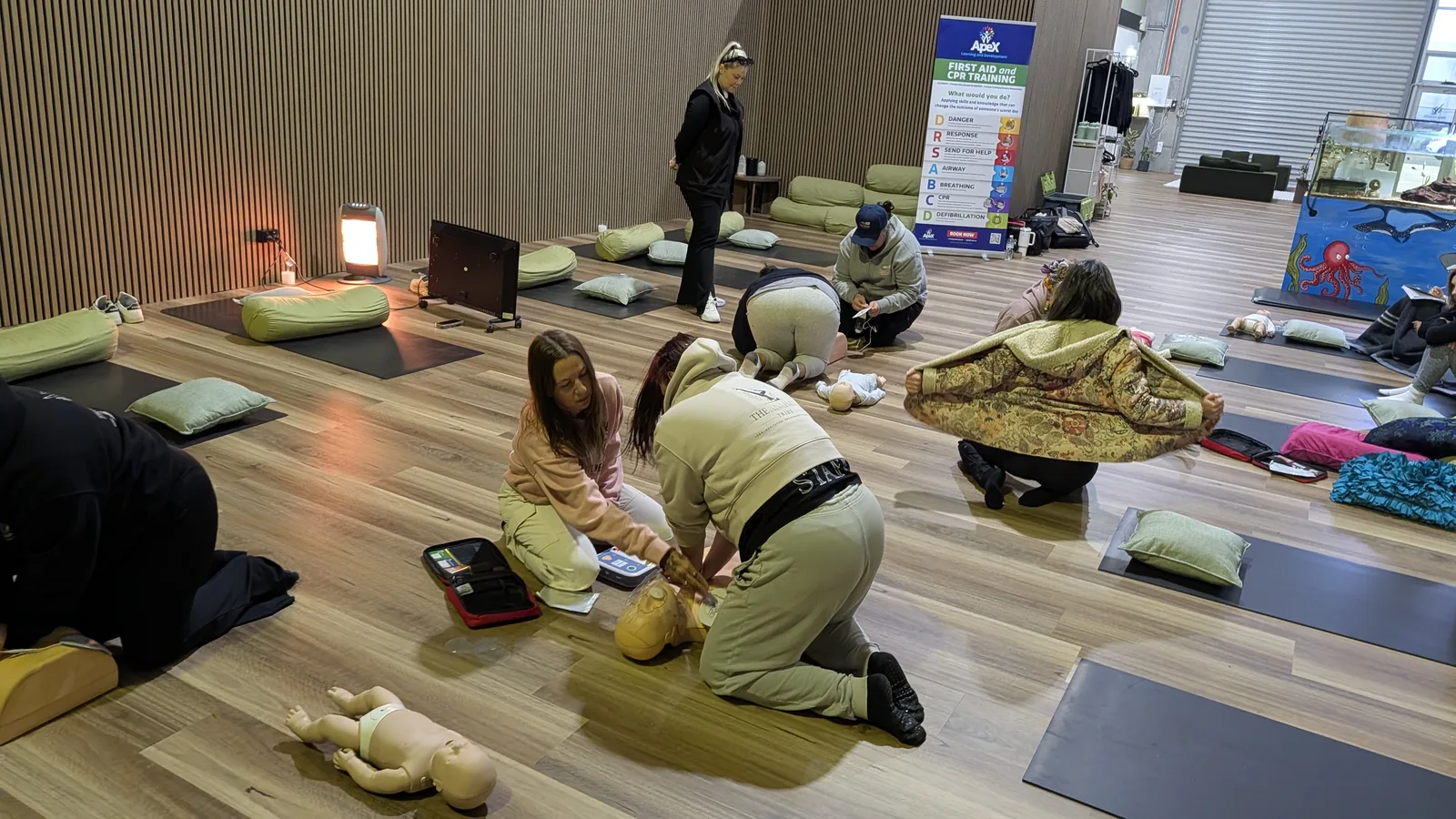
Compressions are physically strange the first time. You have to press harder than instinct permits, on a person who looks like they should not be pressed at all, and keep going far longer than feels reasonable. Nobody arrives at that intuitively. No video installs it. The people who start are usually the people whose bodies have already rehearsed it.
That is the practical case for a face-to-face practical component rather than a purely online certificate, and for treating the twelve-month CPR refresh as a real deadline rather than a suggestion.
Three questions for your workplace
You do not need an audit to make progress this week.
- How many of your people could start compressions without hesitating? Not how many hold a certificate. How many would start.
- Where is your defibrillator, and could your team find it without looking? If there is a cabinet, does anyone know whether it is alarmed?
- When did your first aiders last refresh their CPR? Full first aid is a three-year cycle. CPR is twelve months.
If the honest answer to any of those is "I am not sure", that is the answer.
The one nominated first aider problem
Most workplaces train one or two people and consider it handled. The arithmetic does not really support that. The odds of the trained person being the one standing there, on the day, in that part of the building, are not good.
Training a team is not about redundancy for its own sake. It is about raising the chance that the person who is present is the person who can start.
What we do
We deliver HLTAID009 Provide cardiopulmonary resuscitation and HLTAID011 Provide First Aid as nationally recognised training: online theory first, then a face-to-face practical where the skills actually get into the hands. We run group sessions on site and refresh a whole team at once.
If it has been more than a year, let's talk about getting your team current.
Apex Learning and Development, RTO 46324.
Source: Victorian Ambulance Cardiac Arrest Registry, Annual Report 2024/25, Ambulance Victoria. Victorian data.
HLTAID009 Provide cardiopulmonary resuscitation and HLTAID011 Provide First Aid are nationally recognised units of competency delivered by Apex Learning and Development, RTO 46324.